Answer Engine Optimization (AEO): The Future of SEO in the Age of AI Search
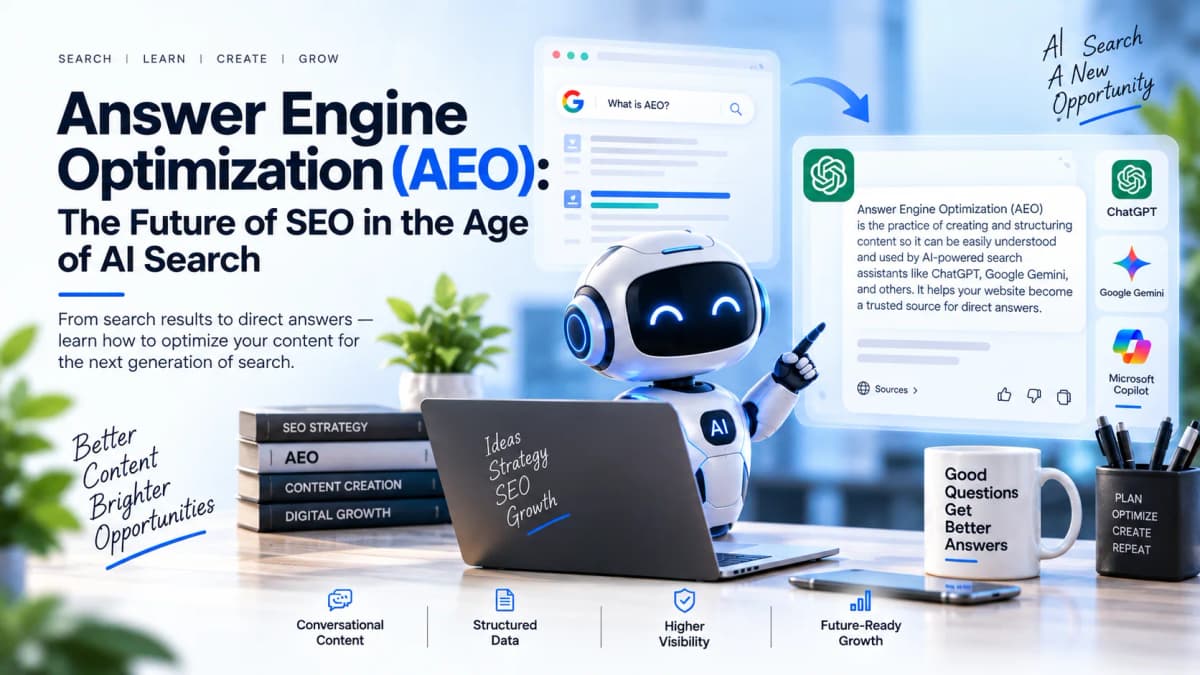
Answer Engine Optimization (AEO): The Future of SEO in the Age of AI Search
Search is changing.
For years, Google and other traditional search engines were the main gateways to information on the web. You typed a query, looked through a list of results, clicked a page, and found your answer.
Now, people can ask the same questions directly to conversational AI tools and AI-powered search experiences.
Instead of searching for:
React hooks tutorial
someone might ask:
How do React hooks work, and when should I use useEffect?
The difference is more than wording. The way people discover and consume information is changing.
This is where Answer Engine Optimization (AEO) comes into the picture.
AEO focuses on creating and structuring content so that search engines and AI-powered systems can understand the information clearly and potentially use it when answering questions.
But AEO isn't a replacement for SEO.
It's another layer of modern search optimization.
What Is Answer Engine Optimization (AEO)?
Answer Engine Optimization (AEO) is the practice of creating clear, structured, useful content that directly addresses the questions people ask through search engines and AI-powered answer systems.
Traditional SEO often focuses on helping a page become visible for relevant searches.
AEO puts additional emphasis on whether the information itself is easy to understand, extract, and use as an answer.
For example, imagine someone asks:
What is Next.js and why is it good for SEO?
A traditional search result might send the user to an article about Next.js.
A conversational search experience may instead summarize the answer and provide links to supporting sources.
Your job isn't to manipulate that system.
Your job is to make your website a genuinely useful source of information.
That means clear writing, logical structure, accurate information, strong topical coverage, and a technically accessible website.
AEO vs. Traditional SEO
AEO and SEO shouldn't be treated as competitors.
They work together.
Traditional SEO focuses on areas such as:
Search visibility Search intent Keywords Technical SEO Internal linking Page experience Content quality Authority
AEO adds another question:
Can this content clearly answer the questions my audience is asking?
Think about it this way:
SEO helps people discover your content.
AEO helps make your information easier to understand in answer-focused search experiences.
Google's current guidance is also clear that the same fundamental SEO practices remain important for AI features such as AI Overviews and AI Mode. There isn't a separate technical checklist that guarantees inclusion in those experiences.
Why Is AEO Becoming Important?
Search queries are becoming increasingly conversational.
People don't always search using two or three keywords anymore. They ask complete questions, compare options, request explanations, and continue with follow-up questions.
For businesses and publishers, this creates an important opportunity.
Your website should not simply contain keywords.
It should contain useful answers.
For example, instead of creating a generic article targeting:
Next.js SEO
you could create a genuinely useful resource answering questions such as:
Is Next.js good for SEO? How does Next.js handle metadata? Does Next.js support structured data? How does server-side rendering affect SEO? How should you create an XML sitemap in Next.js? How can you improve Core Web Vitals in a Next.js website?
This approach creates content around a real topic rather than a single keyword.
For a deeper look at how Next.js can support technical SEO, see our guide to Next.js development for European businesses.
How to Optimize Your Website for AEO
AEO isn't about filling an article with keywords or trying to write specifically for AI systems.
The better approach is simple:
Create useful content that clearly answers real questions.
Here are the practices worth focusing on.
- Use Clear, Conversational Language
Write in a way that is easy for both humans and machines to understand.
Instead of:
React is a JavaScript library utilized for the development of user interfaces through a component-based architecture.
write:
React is a JavaScript library for building user interfaces with reusable components.
The second version is shorter, clearer, and easier to understand.
Good writing is good SEO.
- Answer Questions Directly
Think about the questions your audience actually asks.
For a React authentication article, useful headings could include:
What is authentication in React? How does authentication work? What is the difference between authentication and authorization? Where should authentication tokens be stored? What are common React authentication mistakes?
Then answer each question directly.
Don't force the reader to search through five paragraphs to find a two-sentence answer.
- Use Descriptive Headings
Your headings should communicate exactly what the section contains.
Instead of:
Important Things to Know
use:
How Does Authentication Work in React?
Instead of:
A Better Approach
use:
How to Improve React Application Security
Clear headings create a better reading experience and provide additional context about the content of each section.
- Structure Your Content Properly
Good content structure helps everyone.
Use:
One clear H1 Logical H2 sections H3 subsections when necessary Short paragraphs Bullet points Tables for useful comparisons Ordered lists for processes Descriptive links
Google recommends making links crawlable and using descriptive words that help users and search engines understand the destination.
This is one reason internal linking should be part of your content strategy rather than something added at the end.
- Build Strong Internal Links
Internal linking is particularly important for this article because your Search Console report currently shows:
Referring page: None detected
Your sitemap tells Google that the URL exists, but a crawlable link from an already discovered page gives Google another path to reach it.
I'd connect this AEO article with your existing SEO and development content.
From your SEO-friendly website article
Add a paragraph such as:
As search becomes more conversational, website owners also need to think about how their content can provide direct answers. This is where Answer Engine Optimization (AEO) becomes relevant.
Your existing SEO-friendly website design checklist is an excellent contextual source for this link because it already discusses technical SEO, website structure, URLs, and search visibility.
From your website speed article
Add a relevant section or sentence:
Technical SEO is only one part of modern search visibility. As AI-powered search becomes more conversational, content structure and answer-focused optimization are also becoming important. Learn more about Answer Engine Optimization (AEO).
Your website speed optimization guide already discusses technical SEO, internal links, metadata, structured data, and Next.js, so this is a natural connection.
From your Next.js development article
Add:
Modern SEO isn't only about technical implementation. Content structure and answer-focused optimization also matter. See our guide to Answer Engine Optimization (AEO).
Your Next.js development article already discusses SEO implementation, structured data, metadata, crawlability, and performance, making it another strong contextual link source.
From your Best Web Developer in Sylhet article
You already have this connection:
Read more: AEO: The Future of SEO in a World Powered by AI Assistants
Keep it, but update the anchor text to:
Learn how Answer Engine Optimization is changing SEO
That gives Google more descriptive context about the destination page.
- Create a Topic Cluster Around SEO
Don't stop at one link.
Your existing blog already has several pages that can form a useful SEO cluster:
SEO-friendly website design checklist Website speed optimization Next.js development for European businesses Best Web Developer in Sylhet This AEO article
The AEO article should link out to several of these, while several of these articles should link back to the AEO article.
That creates a connected topical network rather than a single isolated URL.
- Use Structured Data Correctly
Structured data can help Google understand what a page is about.
For a blog article, use appropriate Article or BlogPosting structured data with information such as:
Headline Author Image Date published Date modified Article URL
Google says Article structured data can help it understand article pages and information such as the title, image, author, and dates.
Structured data doesn't guarantee indexing or rankings, so treat it as supporting information rather than an indexing shortcut.
- Keep the Article Fresh and Accurate
AEO is still a developing topic, so avoid making claims that sound more certain than the evidence supports.
For example, don't claim that:
AI systems always prefer FAQ sections.
Or:
Google ranks AEO content higher.
Those statements are too broad.
Instead, focus on what you can actually control:
Clear answers Helpful content Strong information architecture Descriptive headings Relevant internal links Accurate information Technical accessibility Structured data where appropriate
Google's guidance for AI search emphasizes valuable, unique, people-first content and the same core SEO foundations used for traditional Search.
- Add Author and Source Information
For a topic like SEO and AI search, showing who wrote the article can help readers understand the source.
Consider including:
Written by Abdul Jabbar Al Nahid Web Developer & SEO Specialist at Ab Nahid Agency
You can also cite authoritative documentation when making technical claims.
Useful references include:
Google Search Essentials Google's guide to AI features in Search Google's guide to optimizing for generative AI features Google's structured data documentation OpenAI's publisher guidance
These aren't included to manufacture authority. They're useful primary sources that support specific technical statements.
AEO Isn't Just for Blog Posts
AEO principles can apply to many parts of a website.
That includes:
Service pages Product pages Documentation FAQs Portfolio pages Case studies Landing pages Knowledge bases Local business pages
Imagine someone asking:
What services does this web development agency provide?
A well-structured service page can answer that question clearly.
For example, if you're looking for a modern web development solution, your Next.js development services page explains the type of development work your agency provides.
The same principle applies to SEO services, landing pages, WordPress development, and other service categories.
Does AEO Replace SEO?
No.
AEO should be viewed as an additional consideration within modern search optimization.
Technical SEO still matters.
Site architecture still matters.
Page speed still matters.
Internal linking still matters.
Search intent still matters.
Content quality still matters.
Google's current documentation specifically states that the existing SEO best practices remain relevant for AI features in Google Search.
So don't abandon traditional SEO because of AEO.
Build on it.
What About External Links?
External links can make an article more useful when they point readers to reliable primary sources.
For this article, useful references include Google's documentation on:
Search Essentials AI features in Search Generative AI search Structured data
For example, Google's current guidance explains that pages need to be indexed and eligible for normal Search before they can be eligible as supporting links in AI Overviews or AI Mode.
OpenAI also provides publisher guidance for making public websites discoverable in ChatGPT Search, including allowing OAI-SearchBot where appropriate.
The important point is that external references should support the article's claims. They aren't a substitute for having a crawlable, useful website.
The Future of Search Is Becoming More Conversational
The biggest change isn't the introduction of another SEO acronym.
It's how people interact with information.
Users can now ask longer questions, request comparisons, ask follow-up questions, and expect direct explanations.
That means websites need to communicate information clearly.
For developers, this means thinking about content structure alongside technical implementation.
For businesses, it means making sure their website clearly explains:
Who they are What they offer Who they serve What problems they solve Why their information can be trusted
The goal isn't to write for machines.
The goal is to create information that machines can understand because humans can understand it easily too.
Final Thoughts
Search isn't disappearing.
It's evolving.
Traditional search engines continue to matter, while AI-powered search and conversational interfaces are creating new ways for people to discover information.
That's where Answer Engine Optimization (AEO) becomes relevant.
The strongest approach isn't to chase every new AI-search trend.
It's to build a website around fundamentals that remain valuable:
Clear information. Useful answers. Logical structure. Technical accessibility. Strong internal linking. Accurate and trustworthy content.
Those principles can help your content perform across traditional search and newer AI-powered discovery experiences.
The web may be becoming more conversational, but one principle remains constant:
Create information that genuinely helps people, and make that information easy to understand.